The CFO of a mid-sized FMCG brand in Southeast Asia opens a deck on a Thursday morning. The deck shows that traditional trade volumes for their flagship SKU have declined 18% year-on-year across their top three distributors. The same deck shows that their eCommerce revenue - Shopee, Lazada, Tokopedia - has grown 42% for the same SKU over the same period. The CFO concludes, reasonably, that the eCommerce channel is cannibalising the distributor channel. The commercial team acts on that conclusion. They reduce promotional support to the distributors to protect eCommerce margins. They accept the distributor complaints about declining volumes as an inevitable transition cost. Six months later, the distributors are in a much worse position than the cannibalisation data suggested they should be. One of them begins to default on payments. The commercial team blames eCommerce. They are blaming the wrong thing.
Two different phenomena, one indistinguishable signal
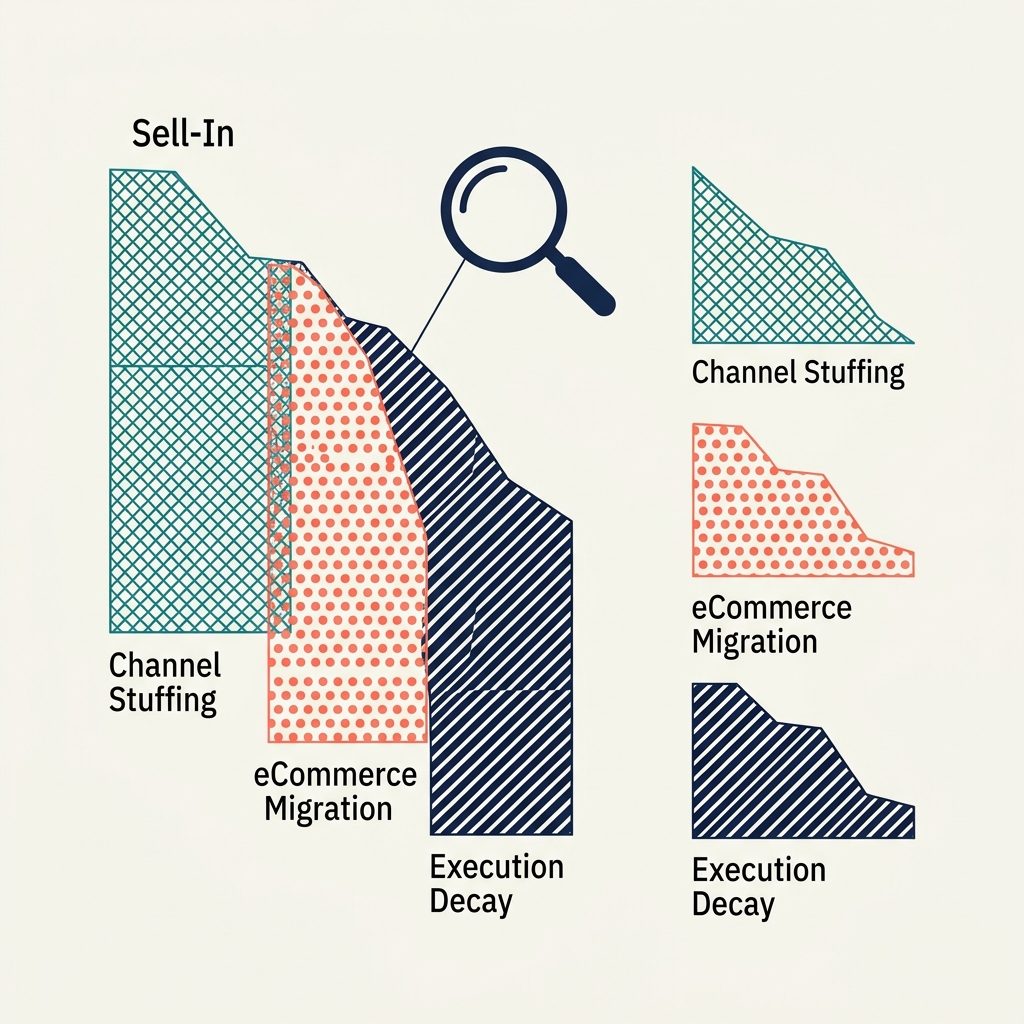
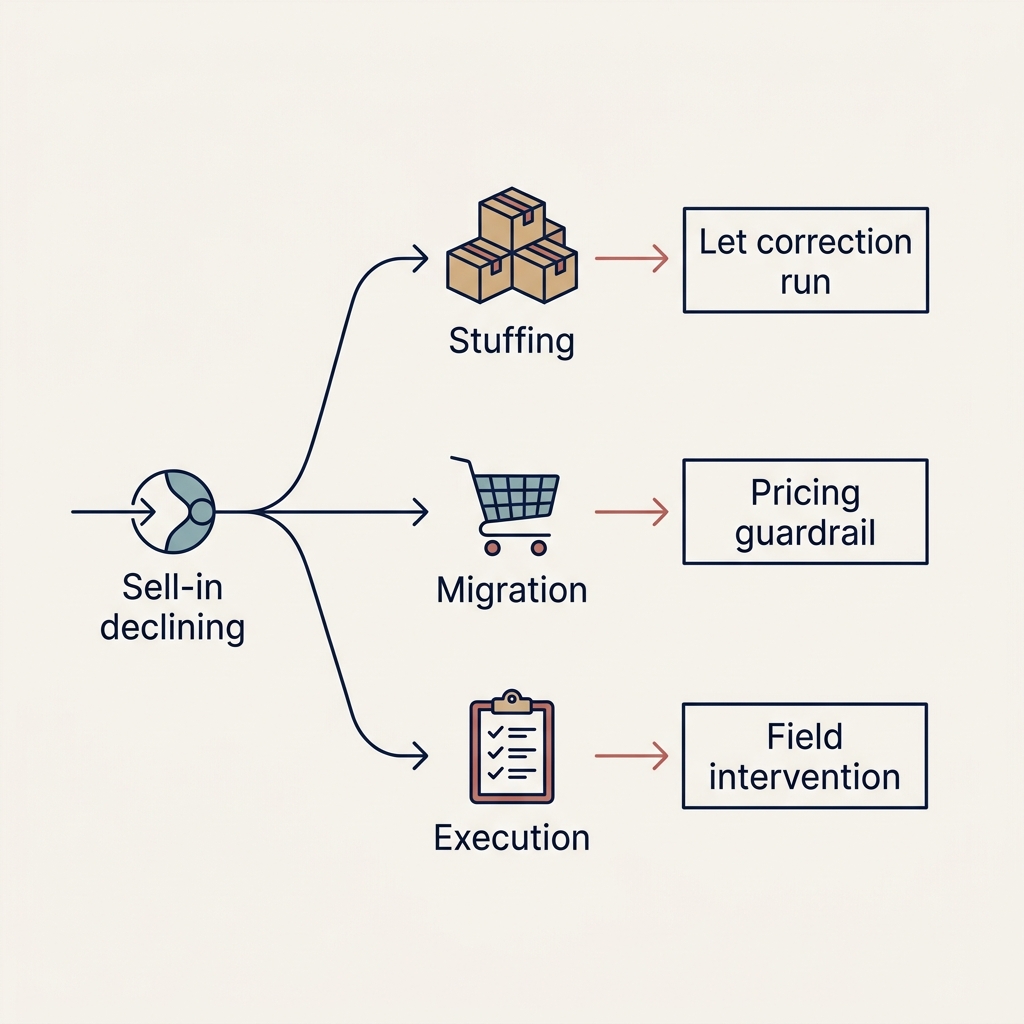
What the commercial team missed is that their sell-in data to distributors shows the combined effect of at least three distinct underlying phenomena, each of which requires a different intervention. The first is genuine channel migration - consumers who used to buy at a workshop or corner store are now buying online, and the offline volume loss is real and permanent. The second is channel stuffing - the distributor loaded inventory ahead of a price increase or a promotion expiry, and the current period's sell-in decline is a natural correction, not a trend. The third is execution decay - DSR coverage or visit frequency has dropped, outlets are de-listing SKUs, or a competitor promotion has taken share at the shelf. Each produces the same headline signal: sell-in is down. Each requires a completely different response.
If the problem is migration, the right move is a pricing guardrail on eCommerce to protect the distributor floor price, combined with a possible SKU rationalisation that moves the most online-vulnerable SKUs to a managed parallel posture. If the problem is channel stuffing, the right move is to let the correction play out without artificial intervention, which will distort the next quarter's numbers. If the problem is execution decay, the right move is a field intervention - DSR retraining, competitor response, or outlet-level pricing adjustment - and the eCommerce channel is irrelevant. A single-metric view that reads "sell-in down" cannot distinguish between these three. A system that can distinguish them turns what looks like an intractable strategic problem into three specific, solvable operational problems.
The channel stuffing detector
Channel stuffing has a specific data signature. It is a sell-in spike ahead of a known event - a price increase, a promotion expiry, a contract renewal - followed by a sell-in trough in the period immediately after. The signal is in the inventory velocity divergence between sell-in to the distributor and sell-out from the distributor to outlets. If sell-in outpaces sell-out for two consecutive weeks, and the distributor's inventory days exceed the historical norm by more than 15%, the stuffing flag fires. This is not a novel calculation. What is novel is having the data to calculate it in real time, because sell-out data from distributors has historically been self-reported and unreliable.
When the stuffing flag fires, the commercial team sees it alongside the JBP revenue compliance score. They know immediately that the current month's apparent revenue achievement is artificially inflated and that next month's shortfall is already mathematically determined. They stop incentivising more sell-in. They start managing the inventory run-off. Six weeks later, the distributor's working capital position looks healthier than it would have, the DSR push has been refocused on sell-through rather than sell-in, and the JBP compliance pattern is stable rather than whipsawing between spike and trough.
The eCommerce migration flag
Genuine channel migration has a different signature. The SKU's eCommerce channel fit score is structurally high - Personal Care SKUs, small-basket FMCG, standardised consumer goods - and the offline sell-in decline is correlated with a measurable increase in the brand's own eCommerce volumes for the same SKU. When both conditions hold, the migration flag fires. This is a signal to the commercial strategy team, not to the distributor management team. The distributor cannot fix migration. Forcing them to try will destroy the relationship.
The right responses to a migration signal operate at the SKU-strategy level, not the distributor-management level. A pricing guardrail ensures the eCommerce price does not undercut the distributor protection floor. A SKU posture adjustment moves the most vulnerable SKUs to a managed parallel position - sold in both channels with coordinated pricing and promotion - or to a rationalise-physical position, where the SKU is deliberately moved to online-only and the distributor's JBP coverage targets for that SKU are removed. A digital terms translator converts eCommerce metrics into commercial language the Regional MD understands - units, revenue, channel contribution - so that the discussion with the distributor is honest about what is happening at the consumer level.
Why excluding eCommerce from the JBP matters
There is a specific architectural detail that most FMCG commercial systems miss. If the distributor's JBP revenue target is measured against total brand revenue - including eCommerce sales the distributor did not generate - the distributor has a perverse incentive to inflate their compliance score by claiming credit for eCommerce volume. The JBP commitment needs an explicit exclude-eCommerce flag on every revenue target, or the distributor's reported compliance drifts upward as eCommerce grows, while their actual contribution to the brand's offline economics drifts downward. The distributor wins on the scorecard while the relationship deteriorates on the ground. This is a design-level fix that costs almost nothing to build and solves a category of future disputes before they happen.
The misattribution tax
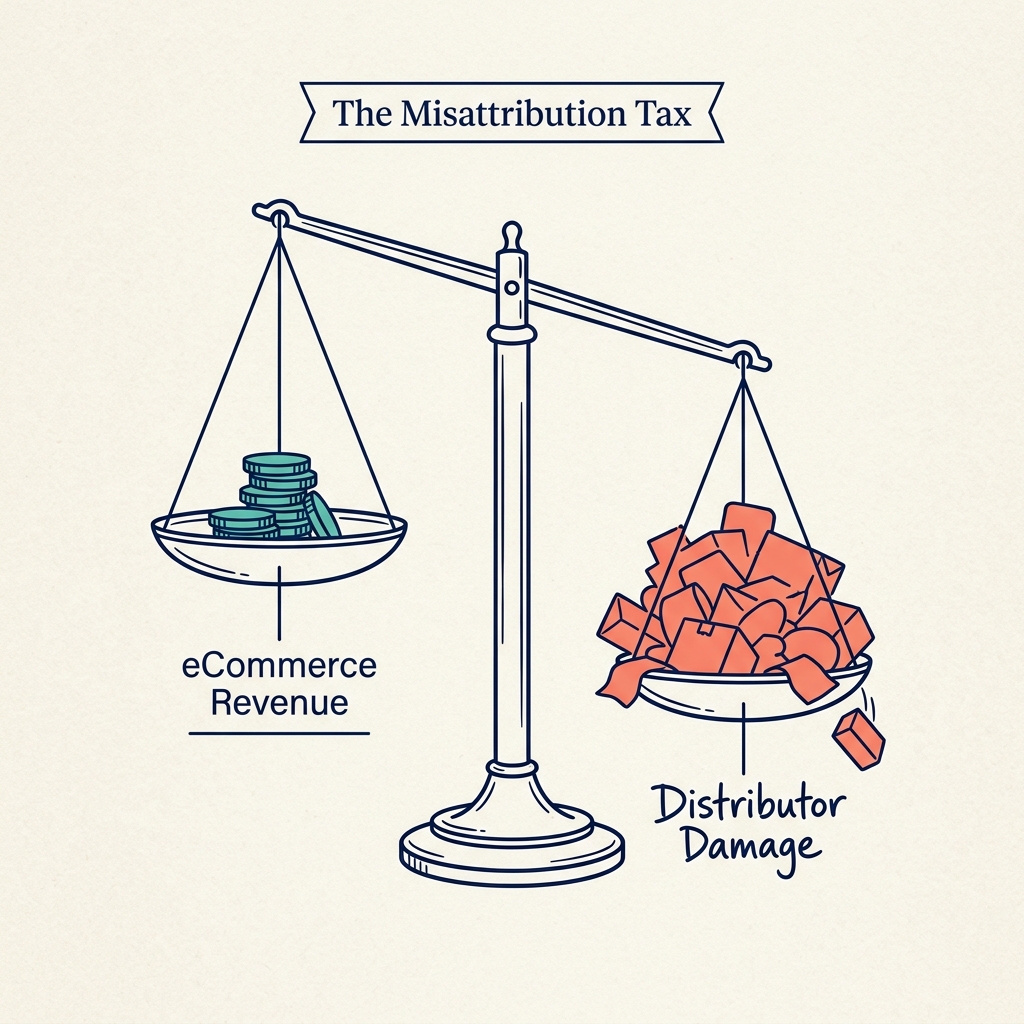
Most FMCG finance teams are paying a misattribution tax right now. They see the headline numbers, draw conclusions that feel obvious, and take actions that make both channels worse. The tax is not the eCommerce cannibalisation itself - that is a real phenomenon and needs a real response. The tax is the cost of mistaking channel stuffing for migration, execution decay for cannibalisation, or one month's noise for a long-term trend. Every mistaken attribution leads to a mistaken intervention. Every mistaken intervention erodes a distributor relationship, a promotional budget, or a strategic SKU posture. The cumulative cost of misattribution in a typical Southeast Asian FMCG portfolio is plausibly larger than the total profit contribution of the eCommerce channel.
A commercial operating system that carries ground truth data from sell-in, sell-out, eCommerce volumes, and pricing observations at the shelf can separate these phenomena. That separation is the difference between an FMCG brand that reads the transition intelligently and one that fights its own distributors while the competitor quietly takes share in both channels.