When a strategy team is asked to design the ideal territory structure for a market, and the same team has spent the previous three weeks auditing the performance of existing distributors in that market, the ideal design will bend toward the incumbents. This isn't a failure of professionalism. It's a predictable consequence of how human cognition works when confronted with concrete detail. Once you know that Distributor X has been the partner in East Java for twelve years, employs 47 people, and has just invested in a new warehouse, the "ideal" territory for East Java will - mysteriously - turn out to have boundaries that suit Distributor X's current capacity.
The failure is so reliable that senior consultants build their reputations on resisting it, and junior consultants learn painfully that their "ideal designs" get rewritten by partners who have seen this movie before. But the fix most organizations reach for - just try harder to be objective - doesn't work. Objectivity is not a willpower problem.
Incumbency bias is an architecture problem. The fix is architectural.
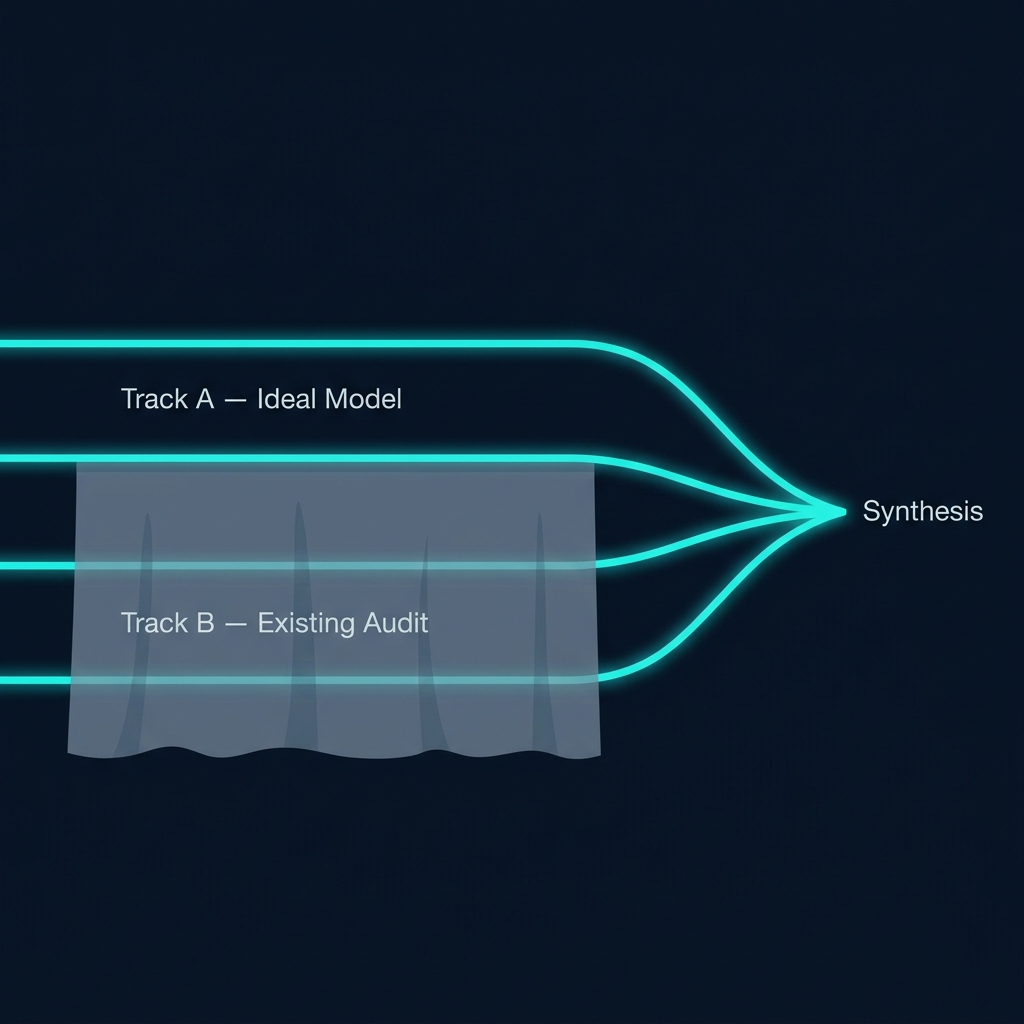
Here is the architecture that works. The strategic assessment of a market runs in two parallel tracks from the outset, with a hard separation between them.
Track A builds the ideal model. What does the market actually need, absent any consideration of who is currently serving it? Where should the territory boundaries sit based on outlet density, population, cost-to-serve, and logical coverage routes? What capabilities does an ideal distributor in this market need to have? What scale? What financial profile? What consumer and trade relationships? Track A starts from the market, works forward to the operator profile, and terminates in a specification for what "winning" looks like. Track A researchers have no information about the current distributor base. They are protected from that information, not asked to ignore it.
Track B audits the existing distributor base. What does each current distributor actually do? What is their P&L health? What is their capability profile? What is their coverage accuracy? How is their relationship with the tenant? Track B runs simultaneously but its outputs are sealed from Track A. Sealed literally - in a software system, the Track B outputs are not queryable from the Track A workstream; in a consulting engagement, the two teams are separated and instructed not to share findings.
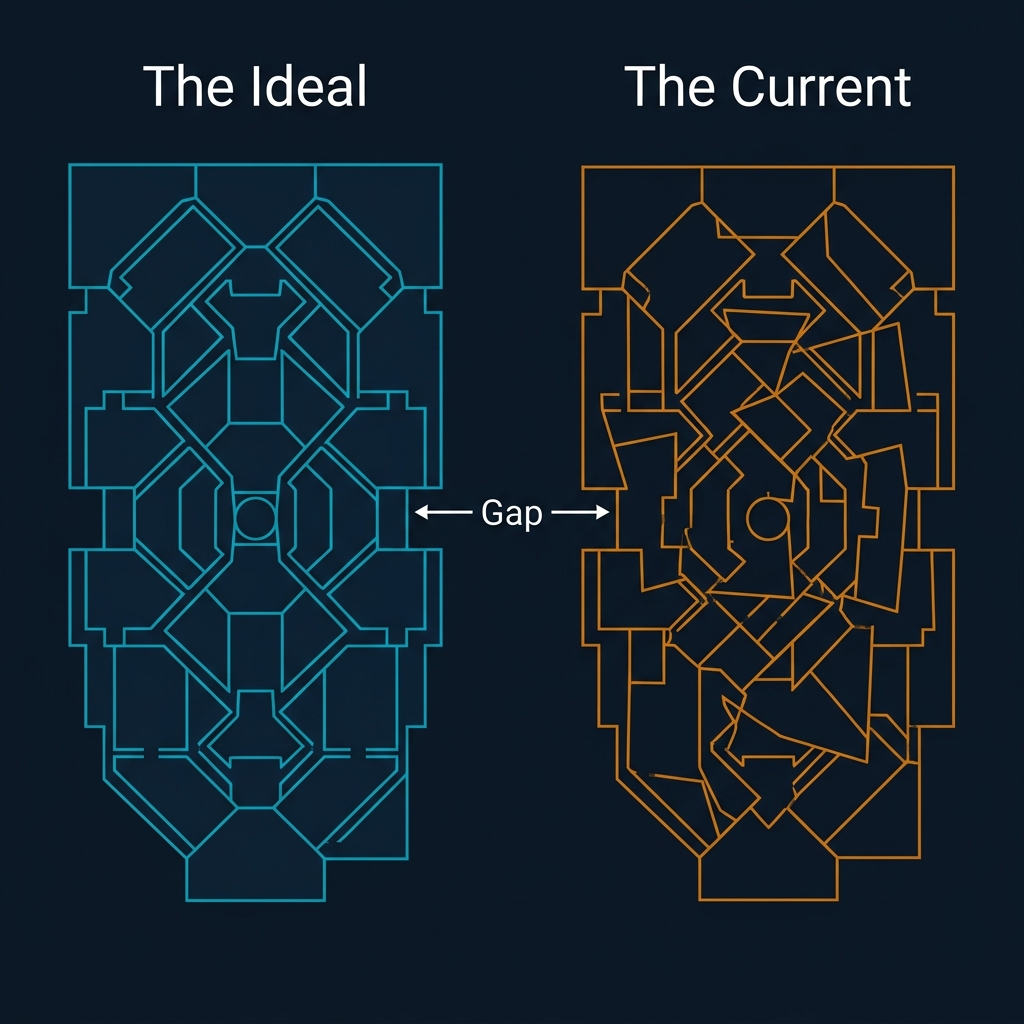
Track A and Track B meet for the first time in synthesis. At that point - and only at that point - the two models are placed side by side. The ideal model (Track A) is compared to the current reality (Track B). The gap between them is the strategic recommendation.
This architecture sounds obvious when written out. In practice almost no consulting engagement runs this way, and almost no internal strategy team does either. The temptation to cross-reference is too strong. The information latency feels inefficient. "Wouldn't it be faster if Track A knew what Track B was finding?" Yes - and the cost of that speed is that Track A's answer bends toward what Track B has already accommodated.
Three specific things go wrong when the tracks aren't separated.
First, territory boundaries get drawn around incumbents rather than around markets. East Java is one territory, with that boundary, because Distributor X has been servicing it that way for twelve years. The "ideal" boundary - which would split it into two territories based on outlet density - gets quietly discarded because it would mean "rationalizing" Distributor X's territory, and nobody wants to open that conversation. The ideal stays unexamined. The market pays the cost.

Second, distributor requirements get calibrated to incumbent capabilities. The ideal distributor for this territory needs USD 5M in working capital, modern warehousing, and a digital ordering system - but Distributor X has USD 2M working capital, a 1990s warehouse, and paper ordering. The requirement quietly softens to "USD 2–3M working capital, adequate warehousing, order capture system." The ideal has been redefined around the reality. The market never sees what the ideal actually required.
Third, the gap analysis - which is the whole point of the exercise - gets compressed or eliminated. If Track A has already accommodated Track B's reality, there is no gap to analyze. The recommendation becomes "continue with minor adjustments," which is exactly what a senior leader who wanted to defend the status quo was hoping for. The disruption the market needed doesn't happen.
The sealed-track architecture forces the gap to remain visible. When Track A specifies an ideal distributor with USD 5M working capital and Track B shows that the current distributor has USD 2M, the gap is on the page in front of everyone. The recommendation can be "invest to close the gap," or "find a different distributor," or "accept that this territory cannot be won at the specified ambition" - but it cannot be "pretend the gap doesn't exist," because the architecture won't let it.
There is a cost to running things this way, and it's worth naming honestly.
Track B researchers often find information that would improve Track A. A distributor's behavioral quirks that explain their coverage pattern, a competitor dynamic that's not visible in public data, a market nuance that only comes out in interviews. Track A has to design without these. Some of what Track A specifies will turn out to be unnecessary given facts Track B knew. This is real waste.
The waste is acceptable because the alternative is worse. The information leak that goes "Track A, you don't need to worry about outlet type X because Distributor Y already handles that" is the exact mechanism by which incumbency bias enters the model. You can't selectively leak - any leak contaminates the architecture. So you pay the cost of not leaking, and you accept that Track A will sometimes overspecify things that Track B already knew were solved.
The synthesis phase is where skill matters. Someone senior has to merge the two tracks, identify the genuine gaps, distinguish them from things Track A overspecified, and build a recommendation that respects both the market's actual requirements and the tenant's actual resources. This is consulting judgment, not architecture. But the architecture is what makes the judgment possible - it ensures the two tracks arrive at synthesis with clean, independent views that can actually be compared.
Without the architecture, synthesis collapses into accommodation. With it, synthesis becomes honest.
For anyone who has ever sat through a strategy presentation where the "ideal state" looked suspiciously like a modestly prettier version of the current state, the sealed-track architecture is the fix. It's uncomfortable. It runs slower. It requires discipline most consulting engagements don't have.
It also produces strategy that actually changes the business. That is the point.
There is a common objection to this architecture that deserves a direct answer. The objection goes: "We operate in a market where the distributor landscape is limited. There aren't meaningfully different alternatives to the incumbents. Track A designing in a vacuum will produce an ideal that can't be realized, and we'll have wasted effort building it."
This objection is often raised in markets like Indonesia, where the number of credible distributor operators in any given category is genuinely small, and the answer to "who should serve this territory" is often "the same three names everyone else is using." In those markets, the argument goes, the Track A/Track B separation is ceremonial - you'll end up with the same distributor you started with, because there isn't an alternative.
The argument is partially right and mostly wrong.
It's partially right in that the final outcome often does end up with the incumbent in many territories. What changes is the terms on which the relationship continues. Without Track A/Track B separation, the relationship continues on whatever terms have accumulated over the years - often including grandfathered margin structures, boundary definitions that no longer make commercial sense, and implicit exclusivity arrangements that were never formally revisited. With the separation, the continuation is negotiated against an explicit ideal-state benchmark. The incumbent knows what the ideal distributor for the territory looks like. They know the gap between their current operation and that ideal. They know what they'd need to do to close it. The tenant knows the cost of continuing the relationship on current terms versus the cost of closing the gap. The conversation is different, even when the distributor is the same.
It's mostly wrong because the assumption that there are no alternatives is usually itself a product of incumbency bias. The alternatives exist but haven't been surveyed, because the current strategy process didn't require surveying them. When Track A specifies "ideal distributor in East Java needs USD 5M working capital, modern warehousing, digital ordering, and multi-category experience," the sourcing team goes and finds who fits that profile. Often they find two or three candidates that weren't on the tenant's radar because the tenant had stopped looking. Sometimes they find none, and Track A's specification gets revisited with the benefit of concrete market feedback rather than assumption.
Either way, the search is real. Tracking the alternatives is part of what makes the architecture valuable. The "there are no alternatives" position, confidently held without evidence, is the exact mindset Track A/Track B separation is designed to challenge.
There's a second-order benefit to the architecture worth naming explicitly.
When Track A and Track B run separately and synthesize at the end, the synthesis document becomes a durable artifact - a record of what the ideal looked like at a specific point in time, what reality was, and what the gap was. Two years later, when the market has moved and strategy needs to be revisited, the synthesis document provides a baseline. The question "has the gap closed, widened, or shifted?" has a concrete answer, because both Track A and Track B produced explicit reference points.
Organizations that run strategy without this separation tend to have no such baseline. The previous strategy was a document; the current state is whatever people say it is; the comparison is impressionistic. The next strategy process starts from scratch, because there's nothing to start from. Each strategy cycle is expensive because each one is full-depth.
With the separation, strategy cycles can be differential. What's changed in the ideal model since the last cycle? (Usually not much - the structural logic of the market evolves slowly.) What's changed in the reality? (Often a lot - distributor performance, competitive positioning, market dynamics.) The next synthesis is focused on the deltas rather than building from a blank page. The cost of strategy drops while the quality improves.
This is a capability that compounds. Organizations that adopt the architecture and maintain it across multiple cycles develop a level of strategic self-awareness that organizations without it can't match. They know what they know. They know what's changed. They can have strategic conversations at a higher level because the lower levels are already documented.
One last note on the operational mechanics, because the architecture sounds more complex in principle than it is in practice.
In a consulting engagement, Track A and Track B are different teams or different individuals within the same team, with an explicit instruction not to share findings. The separation is enforced by practice and by the engagement leader. It's social, not technical. Any reasonably disciplined team can maintain it for the eight-to-eleven weeks of a typical strategy engagement.
In a software platform, the separation is enforced by access control and workflow sequencing. Track A workstream screens and data views are separated from Track B screens and data views. The platform doesn't surface Track B information in Track A screens until the synthesis phase is explicitly entered. The architecture makes the right behavior the default.
Neither approach is hard to implement. What's hard is the commitment to actually doing it - accepting the speed cost of not letting information flow between tracks, maintaining the discipline when it feels artificial, resisting the temptation to short-circuit when the schedule is tight. The architecture is simple. The discipline is where the real work happens.